The Academy of Early Music

Ann Arbor, Michigan


Academy 2008-09 Season: From Ann Arbor to England

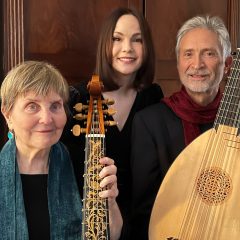
An exciting new season of early music events begins in October with Ann Arbor’s own La Gente D’Orfeo, followed by an unusual duo harpsichord concert, and continues in 2009 with a Valentine’s Day concert by a London-based lute and countertenor duo. 


Grail Singers Perform Renaissance Music

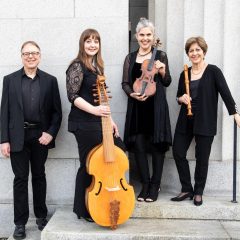
At 8:00 on Saturday, May 16th, the Ann Arbor Grail Singers will perform an English and Italian Renaissance program—featuring music by Tallis and Palestrina—at St. Andrew's Episcopal Church, 306 N. Division, Ann Arbor.  They will be accompanied by Deborah Friauff on keyboard, Marilyn Fung on viola da gamba, and Beth Gilford on recorder.


The 16-voice women’s choir has performed in the Detroit Institute of Arts “Brunch with Bach” Series, at the Toledo Art Museum, at the University of Michigan Museum of Art, and at other venues in Michigan and Ohio. The Ann Arbor Grail Singers have been lauded for the beauty of their sound, and “their musicality, precision, balance, and intonation” (Current Magazine). 


A feature of the Michigan musical scene since 1995, the Ann Arbor Grail Singers were founded and directed until her death by Lynn Malley, a choral conductor for over thirty years, who led workshops in chant and sacred music both in the U.S. and abroad. The Grail Singers were then directed by Deborah Friauff from 2006 – 2008.


The choir’s newly appointed director is Carmen Cavallaro, who has been active in the local early music community since Ars Musica days.  Carmen sang tenor with Vox early music ensemble and currently sings in the Birmingham First Chamber Choir.


About the Program and Composers

The Ann Arbor Grail Singers’ program features music by Palestrina, Tallis, and Cozzolani, including Thomas Tallis’ Magnificat (from the “Short” Evening Service), Palestrina’s Magnificat primi toni, a selection of medieval chant, and these other pieces by Tallis and Palestrina:


  • Ego sum panis vivus (Palestrina)

  • Audivi vocem de caelo (Tallis)

  • Loquebantur variis linguis (Palestrina)

  • Lamentationes Jeremiae Prophetae, Lectio I (Palestrina)

  • Sancte Deus (Tallis)

  • Pleni sunt coeli (Palestrina)


Giovanni Pierluigi da Palestrina was the most famous representative of the Roman School of musical composition. His Missa sine nomine was particularly attractive to Johann Sebastian Bach, who studied and performed it while he was writing his own masterpiece, the Mass in B Minor.


Thomas Tallis flourished as a church musician in 16th century England, where he was one of the most important composers of his time. He occupies a primary place in anthologies of English church music, and is considered among the best of its earliest composers.


The concert concludes with the dramatic dialog O caeli cives by the Benedictine nun Chiara Margarita Cozzolani.  Cozzolani was abbess of the convent of Santa Radegonda, one of the most celebrated ensembles of women musicians in 17th century Italy.


Mark Your CalendarsThe Ann Arbor Grail Singers’ concert will take place at 8:00 p.m. on Saturday, May 16th, at St. Andrew’s Episcopal Church, 306 North Division, Ann Arbor. Concertgoers have permission to park in the Community High School and Ann Arbor News parking lots, each just a block away (see the Downloads link at the bottom of this page for a parking map). Open seating tickets, available at the door from 7:30, are $15 general admission, $12 seniors, $5 students.  For more information about the program and the performers, call 734-662-0631.


Giving a Concert?  Rent the Academy Organ!

If you attend early music concerts in Michigan or Ohio, you've probably heard the continuo organ owned by the Academy of Early Music.  Made in Holland by Gerrit Klop, the Academy's organ is designed for chamber music and choral accompaniment, with a transposing keyboard for performances in either A415 or 440.
To achieve the mild, yet carrying, tone prized in continuo organs, the pipework of the Academy organ is made entirely of wood, following historical examples such as the 1610 Compenius organ made in Copenhagen. Its small size and solid construction make it easy to transport.

The dimensions of the organ are 35-1/2" high x 44-1/2" wide x 19-1/4" deep. The stops include one each at 8', 4' and 2', each divided in halves (bass and treble).  Additionally, there is a treble compass 3' (i.e., 2-2/3') stop.  The compass of the keyboard is 54 notes, CC to f''.

The Academy's continuo organ is available for rental by interested organizations and individuals.  Rental fees for the Academy organ are $400 for up to 120 hours (i.e., 5 days), and $750 for 6 to 12 days.  Fees for longer rentals may be negotiated with the Academy.  Please note that these fees are different from those printed in the previous newsletter, as the Academy Board subsequently revised the fee schedule. Insurance and other requirements apply to rentals.

Academy members may use the continuo organ at substantially reduced rates:  $100 for up to 120 hours (i.e., 5 days), with longer rental periods negotiable.  The Academy's insurance covers use of the organ by Academy members.

All users of the organ are responsible for transporting it to and from its Ann Arbor storage location.  For details, address your inquiry to Eberhard Gerlach (e-mail epg@ams.org or phone 734-663-6419).


Why Join the Academy?


    "There we should talk over the lessons of the day, or lose them in Musick, Chess, or the merriments of our family companions.

    The heart thus lightened, our pillows would be soft, and health and long life would attend the happy scene."

    (Thomas Jefferson, 1771)

    Home | About Us | Story of  a Concert | Calendar Events | Downloads | Links and Resources | Contact Us

    Questions or problems regarding this web site should be directed to Webmaster
    Copyright © 2005- 2009  The Academy of Early Music. All rights reserved.
    Last modified:
    04/28/2009